
Article directory
How to set goals for Taobao and Douyin operations?
- Don't just set sales roughly, it's useless.
- becauseInternet marketingOperations also don't know what to do around sales?
- Therefore, to operateWeb PromotionGoal, what to do?to quantify.
- For example, make 8 main pictures and find the best one.
This is OKR - Objectives and Key Results.
Repeatedly holding meetings and teaching all operations to set goals basically solved the problem of laziness in operations, but if the target direction is wrong, no matter how hard you try, you will not be able to achieve results.
Find the right direction and goal, the performance will come out easily!

LearnE-commerceORK operation management method
Objectives and Key Results (OKR) management methods, basically from various large companies:
- Learned the OKR management method from Google.The best use of this method in China is ByteDance.
- Learned talent density from Netflix and improved talent quality.This is also the best use of ByteDance in China.
- Learned 271 eliminations from GM.This is where Alibaba China works best.
- Learned the assessment score and bonus system from Alibaba and Huawei.
- Learning from Kyocera is Amoeba management and corporate culture.
These good systems can help e-commerce companies improve management efficiency and solve management problems.
We learn these systems and then adapt them to methods that are more usable by smaller companies.
What are OKRs?
The full name of OKR (Objectives and Key Results) is "objectives and key results". It is a simple and effective system for enterprise management by objectives, which can penetrate the management of objectives from top to bottom to the grassroots level.
- The system, developed by Intel Corporation, was introduced to Google by investor John-Doerr less than a year after its founding and has been in use ever since.
OKRs are a set of management tools and methods for defining and tracking goals and their achievement:
- This method was invented by Intel in 1999, and was later promoted by John Doerr to high-tech companies such as Oracle, Google, and LinkedIn, and gradually spread, and is now widely used in IT, venture capital, games, creativity, etc. The size of the business unit.
Origin of OKR
- The origin of OKR can be traced back to Drucker's management by objectives theory, whose core idea is to advocate the transition from command-driven management to goal-driven management.
OKRs create context
Theoretically, KPIs must be formulated in strict accordance with SMART standards, and whether it reaches or even reaches the proportion (less than 100% or greater than 100%) must be measurable.
But this leads to a problem, some things are worth doing, but you can't measure and therefore can't set goals until some of them are done. At this time, you fall into the chicken-and-egg problem.
A more conservative approach is to not write this KPI first, or write a very low target value. Anyway, it is not uncommon to change the KPI at the end of the quarter.Some teams often do not complete the work of KPI formulation until the end of the quarter. At that time, what can be accomplished and what cannot be accomplished is basically determined. Of course, KPIs can be basically achieved.
A more serious problem with KPIs is that in order to accomplish a measurable goal, it is possible that the actual means of execution will be the exact opposite of the unmeasurable vision that the goal is to achieve.
We hope that users prefer to use our products, because they like the inability to measure, so the PV is written into the KPI. (It is true that everyone does not understand advanced concepts such as NPS or DAU, and only uses PV to measure everything.)
However, in the actual implementation process, we can divide the things that users can complete on one page into several pages to complete. As a result, the PV achieves the target specified by the KPI, but users actually hate our products even more.
In order to cope with KPIs, it is because KPIs are linked to performance appraisal. If the KPIs are not met, it will affect the bonus. Therefore, even if it goes against the interests of the company and the interests of users, you must complete your own KPIs and the department’s KPIs.
OKRs solve all the deficiencies of KPIs.First of all, it is separated from performance appraisal, and performance appraisal is handed over to peerreview (equivalent to a 360-degree evaluation of Chinese companies).Then it emphasizes that the final key result must obey the goal, so if you write on the goal to make users like our product, but the means of your actual implementation of the key result violates this, anyone can see that, naturally you There are only disadvantages and no advantages.
- Since key results are only used to serve the purpose, there is no need to set them early and enforce them like KPIs.
- You are free to change the Key Results as you go, as long as they still serve their original purpose.
- In fact, the most important role of OKR is to help you "stay focused", and "stay focused" can also help you "influence" (of course, someone can have an influence without focus, or even if they are focused, they can't make an impact).
When implementing management by objectives, the following must be done:
- The generation of goals is the result of discussions between senior managers and lower-level managers, rather than unilateral wishes;
- Evaluate individual performance in a self-managing manner;
- Performance evaluation methods must be relevant to objectives, and be simple, reasonable and easily measurable;
- Drucker hopes that through "target management", everyone can give full play to their strengths, promote teamwork, and work towards a common vision. This theory has also become the initial prototype of OKR.
OKR was introduced to China in about 2013, and it was mainly implemented by some start-ups with Silicon Valley background.
Now OKR is gradually sought after by IT, Internet, and high-tech enterprises, and it has become popular. Well-known domestic Internet companies Wandoujia and Zhihu have successfully implemented OKR within their enterprises.
Encyclopedia definition: OKR (Objectives and Key Results) is a set of management tools and methods for defining and tracking objectives and their achievement.
Another definition given by authoritative scholars Paul R. Niven and Ben Lamorte:
OKR is a set of rigorous thinking frameworks and ongoing discipline requirements designed to ensure that employees work closely together and focus their energy on measurable contributions that promote organizational growth.
E-commerce ORK operation and management ideas
According to this definition, the following points can be made clear:
- Rigorous thinking framework: OKR is not simply tracking the results of execution every cycle, but about going beyond the numbers and thinking about what those numbers mean to you and the organization.
- Ongoing Discipline Requirements: OKRs represent a commitment of time and energy.
- Ensuring close collaboration among employees: The purpose of OKRs is to foster collaboration among employee teams and align with organizational goals, not employee performance appraisals.
- Focus: OKRs are used to identify the most critical business goals, not a simple list of to-do items.
- Measurable Contribution: Make sure the end result is measurable, not subjective.
- Promote organizational growth: The ultimate criterion for judging the success of OKR implementation is whether it promotes organizational growth.
- In fact, OKR is nothing new, it is a fusion of a series of frameworks, methods and哲学product;
- Peter Drucker proposed the idea of MBO in the 60s;
- Since then, SMART goals and KPIs have become popular in the 80s. In 1999, John Doerr introduced OKR to Google.
Ready to launch OKRs
The most difficult part of implementing OKR in an organization or company lies in the preparations in the early stage. Blind implementation will only lead to OKR being a mere formality, only its shape, not its magic. The final effect is actually just another form of KPI. Only, it cannot bring any growth to the organization, company and individual.
Therefore, before preparing to implement OKR, think clearly about the following questions.
Why implement OKRs?
Before you start implementing OKRs, ask yourself this question: Why implement OKRs?
If you can't answer this question well, everything you do later is meaningless.
If the answer is just "because Google and Intel use it", "I want to make the company better" and other meaningless empty answers, then it is better to put it on hold until you think clearly about this problem, and let the whole company understand why Implement OKRs?
Due to the rapid development and continuous adjustment of the company's business, it is difficult for employees to quickly adapt and focus on the current company's goals and business, so OKR must be implemented.
At what level are OKRs implemented?
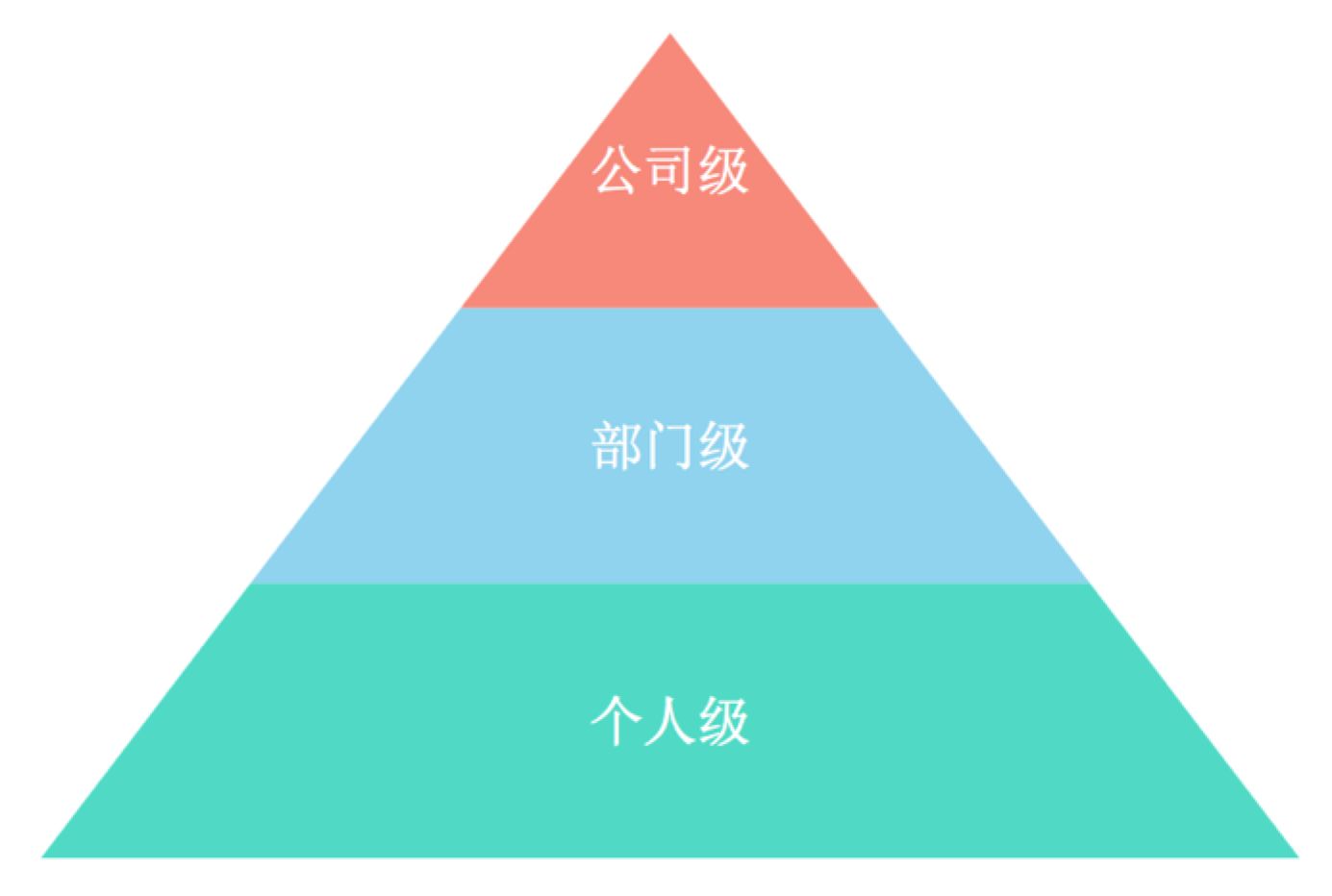
Generally speaking, the implementation of OKR has three levels: company level, department level, and individual level, but this does not mean that the three levels must be implemented together from the beginning.
A better approach is to select a level, gradually promote it from point to surface, and finally implement OKR for all employees.
According to the specific business situation of the company, there are two ways:
- The first is vertical implementation. At first, only the company-level OKRs are implemented. After the successful implementation of the senior management, it is extended to the department level, and finally to the individual level;
- The second is horizontal implementation. Select a business unit or department, and implement company, department, and individual-level OKRs in this business unit at the same time, and finally promote it throughout the company.
The cycle of implementing OKRs
Before starting OKRs, you need to consider how long the implementation cycle will be. The recommended practice is quarterly, but this is not absolute.
- It can be implemented on a monthly basis according to the company's business conditions, and a yearly, half-yearly or weekly cycle is not recommended.
- The cycle is too long, resulting in unreasonable goal setting;
- If the cycle is too short, the formulation of key results becomes a to-do list and cannot be focused on the goal.
- It is recommended to choose a cycle between quarters and months as the company implements OKRs.
A unified understanding of OKRs within the company
The last and most important point is whether all the people involved in the implementation of OKR have a unified understanding of OKR?
Do not implement OKRs before reaching a consensus, otherwise in the process of implementation, due to the deviation of understanding, the final OKR implementation will also be deviated.
The recommended way is to get a unified understanding through the OKR presentation before the start. At the presentation, the three questions mentioned above need to be clearly answered, namely:
- Why implement OKRs?
- At what level are OKRs implemented?
- And the cycle of implementing OKRs.
Choose Effective OKR Tools
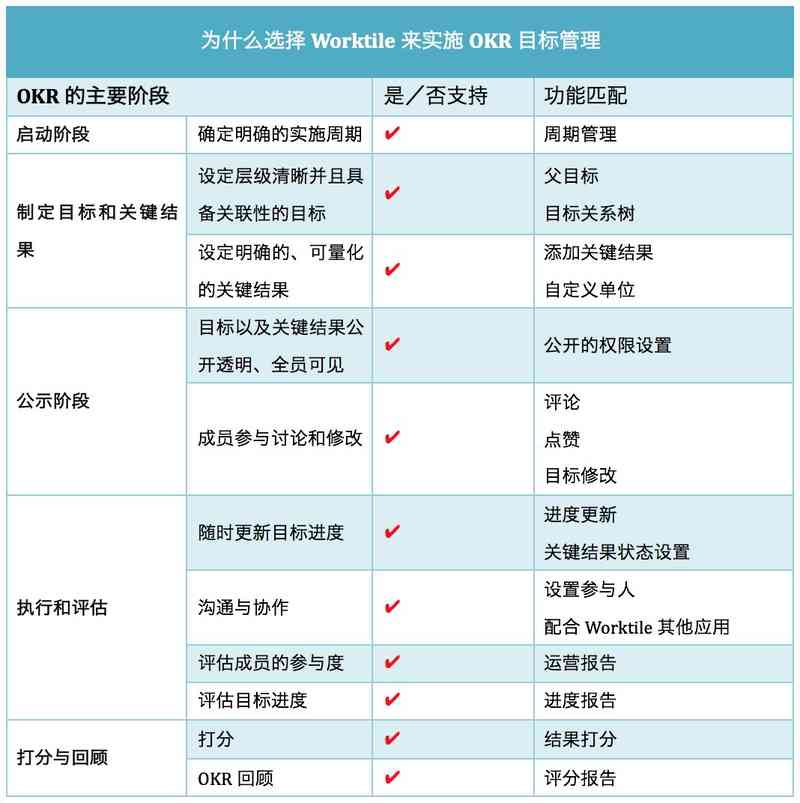
- To implement OKR target management, a suitable platform is needed. Worktile is the first OKR management method in China.softwareForm the implementation of the landing enterprise collaboration platform.
- The Worktile team has conducted in-depth research on OKR target management. Every function and detail in the product design meets the functional requirements of OKR target management.
In addition to Worktile, "Source Target - OKR Target Management Tool" is a more cost-effective software than Worktile:
- Free enterprise version of the source target, you can add up to 10 members;
- can be formulatedunlimitedTarget number, enjoy online learning guidance, customer success support and other benefits.
- After upgrading the paid version, the corresponding fee will be charged according to the team task.
The basic methods and principles of OKR
The basic method of formulating OKRs is: first, set an "objective" (Objective), which does not have to be exact and measurable, such as "I want to make my website better";
Then, set a number of quantifiable "Key Results" that you can use to help you achieve your goals, such as specific goals like "make your website 30% faster" or "15% more integrated."
OKR principle
- OKRs should be quantifiable (time & quantity), e.g.gmailReached success" but "launched gmail in September and had 9 million users in November"
- Goals are ambitious, some challenging, some uncomfortable.Generally speaking, 1 is the total score, and 0.6-0.7 is better., so that you will keep striving for your goals and not meet the deadlines.
- Everyone's OKRs are open and transparent company-wide.For example, each person's introduction page contains a record of their OKRs, including content and ratings.
Introduction and implementation of OKRs
How to introduce OKRs?
Necessary Applicable Conditions for OKRs
The applicable conditions of OKR are roughly divided into two parts.
- Part of it is basic requirements, including trust, openness and fairness.
- Another part is the application requirements.
The definitions of trust, openness, and fairness need no explanation, but they are the guarantees for the long-term implementation of OKRs.
Application requirements are divided into three levels: business, people, and management, which are as follows:
- for business
- for people
- to management
The difference between OKR and KPI
(1) For business:
- Compared with KPIs, OKRs are more suitable for business areas of innovation or process transformation to improve human efficiency.
- Huawei's OKR practical experience shows that: improving the R&D and management of back-end services through innovation is more suitable for OKR;
- Operation and production, this kind of business that is partial to operation, can improve human efficiency through time control, which is more suitable for KPI;
(2) For people:
- When choosing OKR executors, you need to choose employees whose basic material needs have been met, as well as employees who are enthusiastic about doing things (if there is no enthusiasm, you need to promote this first).
- Under OKR management, employees who take the initiative to do things will create higher value.
(3) To the management:
- OKRs are for transformational leaders, not for transactional leaders and leaders who have to manage everything themselves.
- When introducing OKRs, you need to choose a transformational leader to lead the team, or train the original leader to change.
OKR introduction steps
- Do applicability scores for business modules or departments that are ready to introduce OKRs;
- Preaching to create an atmosphere of information disclosure and establish the necessary trust relationship between superiors and subordinates;
- Under the guidance of professional teachers, collective learning formulates suitable for work scenarios O and KR;
- Agreement with the application team for a 1-year OKR effect-creating experimental period, and the performance appraisal will remain temporarily unchanged;
- Provide executors with speech opportunities, create a crowd effect, and make individual differences identifiable;
- Create information maps, documenting key events, each individual's contribution and individual characteristics;
- Formulate the company/business module's own Basic Law and Ten Principles based on practical experience;
- Introduce software based on practical experience (buy the finished product or make it yourself).
OKR considerations
Pay attention to the formulation of OKR: when formulating O (Objective), it must look great, which is usually called THINK BIG.
在具体实例中,就是不能制定“本季度交付2.0产品”这类固定的O,而要制定“本季度产品交付准时率提高10个百分点”、“产品一次报检合格率提升15%达到98%”、“客户满意度提升30%达到80%”这一类与之前对比有显著提高的O。
And when O is formulated, it must be explained to employees that the KR assessment is "decoupled" from O.In layman's terms, even if the formulated O is not achieved, it will not affect the assessment results. As long as the final result is actually improved compared to the original human efficiency, an excellent evaluation can be obtained.
When formulating KR (Key Results), it must be specific, realistic and measurable.For example, "delivering 2.0 products this quarter" is a good KR.
In addition, because of the different nature of O and KR, the KR of the upper department cannot be directly used as the lower O.
OKR key process
From top to bottom, the order of setting goals should be company to department to group to individual.
What an individual wants to do, and what managers want him to do in general, are not exactly the same.
- Then he can first check the goals of the upper management, find the parts that are beneficial to the company's goals within the scope of what he wants to do, and take him out to discuss with his managers and make trade-offs.
- Under certain circumstances, it is very likely that what you want to do will become the development direction of the company in the future. (like the gmail example)
The problem of OKR communication
There are two ways:
- One-to-one communication, where the individual communicates with his manager.Especially when one quarter ends and another begins, negotiating what the key results are.Because not only the individual can say what he wants to do, but also what he wants you to do, the best case is that the two are combined.
- The company-wide meeting is held in the form of a group. The leaders of each group participate and introduce the OKRs of their own group, and finally everyone scores and evaluates together.
OKR basic requirements
Up to 5 Os and up to 4 KRs per O.
Sixty percent of the O's are originally from the bottom layer.The voices of the people below should be heard, so that everyone will be more motivated to work.
All must cooperate, no form of command can appear.
One page is best, two pages is the maximum limit.
OKRs are not a performance measurement tool.For individuals, it serves as a good retrospective.I can quickly and clearly let myself see what I have done and how the results are.
A score of 0.6-0.7 is good performance, so 0.6-0.7 would be your goal.If the score is lower than 0.4, you should think about whether that project should be continued at all.Note that below 0.4 doesn't mean failure, it's a way to clarify what doesn't matter and how to find the problem.Scores are never the most important, except as a direct guide.
Only keep working on KRs if they still matter.
There is a federation to ensure that everyone is working towards the same goals. (In fact, during the implementation of OKRs, you can get everyone's approval and help, which is very interesting)
The key to OKRs
1) Have OKRs every quarter and year, and keep that rhythm.Annual OKRs are not set in one fell swoop.For example, you set OKRs for the next quarter and year in December, and then focus on implementing quarterly OKRs. After all, this is the immediate goal.And over time, you can verify that the annual OKRs are correct and keep revising them.Annual OKRs are indicative, not binding.
2). Quantifiable
3) Available at individual, group, and company levels
4) Company-wide disclosure
5) Score every quarter
Two differences between O and KR:
- O is to be challenging, if it is a sure thing, it is not enough;
- KRs can well support the completion of O, which is obviously quantifiable and easy to score.
The difference between individual, group, and company OKRs: Personal OKRs are your personal presentation of what you will do; group OKRs are not individual packages, but what the group prioritizes; company OKRs are high-level expectations for the entire company.
10 takeaways from OKRs
Point 1: Be absolutely honest
- The essence of a healthy OKR culture is absolute honesty, rejection of personal interests, and loyalty to the team.
Point 2: Measurable
- Key results must be measurable, ultimately observable, and leave no doubt: Did I do it, or did I not?yes or no?It must be simple and easy to judge.
Point 3: Humanities Driven
- Peter Drucker conceived of a new management philosophy: humanistic results-driven management.
- Companies should be “built on trust and respect for their employees – not just as profit machines”.
- Leverage data and constant communication between employees to achieve a balance between the company's long-term and short-term plans.
Takeaway 4: Less is more
- "These carefully chosen targets send a clear message about what to do and what not to do."
- Only 3 to 5 OKRs at most per cycle can help companies, teams and individuals identify what is most important.
- In general, each objective should correspond to 5 or fewer Key Results.
Point 5: Bottom up
- To facilitate employee engagement, teams and individuals should be encouraged to consult with managers.
- The OKRs formulated in this way should account for about half of their respective OKRs.
- If all goals are set from the top down, employee motivation will be frustrated.
Point 6: Get involved together
- OKRs are designed to set priorities through collaboration and dictate how progress will be measured.
- Key results can still be negotiated and adjusted even when company goals have been identified.
- Collective agreement is critical to maximizing the achievement of goals.
Point 7: Be flexible
- If the broader environment changes and the stated goals seem unrealistic or difficult to achieve, some key results can be modified or even discarded during execution.
Point 8: Dare to fail
- Grove writes: “If everyone sets goals higher than they can easily accomplish, the results tend to be better. If you want both yourself and your subordinates to perform at their best, then goals like this tend to be better. The way it is formulated is very important.”
- Certain operational goals must be met in full, but incentivized OKRs can feel stressful and even impossible to achieve.Grove calls this type of goal a "challenging goal," and it pushes an organization to new heights.
Point 9: Fair Use
- The OKR system "is like giving you a stopwatch so you can diagnose your performance at any time.
- It is not a legal text based on performance appraisals".
- To encourage employees to take risks and prevent passive participation, it is best to separate OKRs and bonus incentives.
Point 10: Patience, Perseverance
- Each process requires trial and error.
- It can take an organization 4 to 5 quarters to fully adapt to the system, and it often takes longer to build mature targets.
Application case analysis of OKR
Here are 2 practical cases:
- Case XNUMX: Google employee OKR evaluation
- Case XNUMX: OKRs for artists
Case XNUMX: Google employee OKR evaluation
When Rick Klau, a partner at Google Ventures, Google's venture capital arm, was in charge of Blogger, Google's blogging platform, he set several goals each quarter, one of which was to "strengthen Blogger's prestige"— — Blogger was already huge at the time, but its popularity was being eroded by emerging platforms like Tumblr.In response to this goal, Crowe listed five key results that are very easy to measure, including speaking at three major industry events, coordinating Blogger's 5th anniversary PR campaign, creating an official Twitter account and participating in regular discussions, and more.
Crow also said that Google has both annual OKRs and quarterly OKRs: annual OKRs lead the year, but they are not fixed, but can be adjusted in time; quarterly OKRs cannot be changed once they are determined.Additionally, Google has different levels of OKRs from company, team, manager to individual, all of which work together to ensure that the company is running as planned.
Googlers typically set 4 to 6 OKRs per quarter, and too many goals can be overwhelming.At the end of the quarter, employees are required to score their key results—a process that takes only a few minutes, and ranges from 0 to 1, with an ideal score between 0.6 and 0.7.A score of 1 indicates that the goal is set too low; if it is less than 0.4, there may be a problem with the working method.
At Google, from CEO Larry Page down to every frontline employee, everyone's OKRs are publicly available internally. Everyone can see any colleague's current OKRs and past OKR scores in the employee directory. This transparency helps Google employees understand their colleagues' work—for example, when Crowley is in charge of the YouTube homepage, some colleagues might want to upload a product promotion video. They can then review Crowley's OKRs to understand his work that quarter and determine how to negotiate with the YouTube team.
OKRs are not a metric that determines employee promotion, but they can help employees focus on their accomplishments.Crowe says that as he prepares for a promotion, he can see at a glance what he has done for the company by looking at his OKRs.
Google's OKR mechanism, including:
- Mission: What is the purpose of our existence?
- Vision: Outline a blueprint for the future in words.
- Strategy: priorities and priorities.
- Goal: Quantify what has been achieved in the near-term focus.
- Key Result: How do we know how far we are moving towards our goal?
- Tasks: Break down key results into specific actions and quantitative tasks.
Case XNUMX: OKRs for artists
1. The company's goals determine the team 's goals. The team's goals determine the individual's goals.
When setting goals, individuals should refer to the goals of the company and the team, so that the goals of the individual are consistent with the goals of the team and the company.
While art is often not the core business of a team or department, goals should be set as closely as possible to the team and company goals.
2 The company's goal is to achieve XXX million in quarterly sales of XX products.Then the artist's quarterly goals can be formulated as:
- O: Beautify and package XX products to improve users' acceptance of XX products.
- KR: Produce a 16-page 32K brochure [completed on XX month XX].
- KR: Unify the styles of the product's homepage and first-level pages into XX style (more professional and friendly) [completed on XX month XX].
- Note: KR must be quantified, both in quantity and in time.
Hopefully, the article "How to Customize Taobao/Douyin Operational Goals and Plans? E-commerce ORK Operational Management Ideas" shared on Chen Weiliang's blog ( https://www.chenweiliang.com/ ) will be helpful to you.
Feel free to share this article's link: https://www.chenweiliang.com/cwl-2075.html