
Article directory
Videos shot with mobile phones garnered over 10 million likes? The secret to their popularity, even surpassing that of cameras, isn't the equipment!
self-mediaThe key to success: 90% content + 10% device; a mobile phone is enough.
Given the overwhelmingly positive response from netizens regarding the filming equipment.
But to be honest, after using so many devices, I realized that the best and most practical one is actually the mobile phone.
A phone like the iPhone 13 is perfectly adequate and can easily handle the vast majority of shooting scenarios.
Many people always feel that the photos taken with their mobile phones are of poor quality, but the problem is not with the phone itself, but with the lighting.
With just a simple addition of lighting, the quality of images taken with a mobile phone can instantly double.
Whether it's creating product demonstrations, daily vlogs, live broadcasts, travelogues, production traceability, or restaurant reviews, mobile phones are the most convenient "main force."
The true purpose of a camera: not an essential necessity, but only suitable for specific scenarios.
Cameras are really bulky and inconvenient to carry around.
Its core function is actually to shoot advertising blockbusters, art films, commercial films, and exquisite food photography that requires extreme detail.
For the daily work of ordinary self-media creators, the advantages of a camera are not fully utilized and it is really not very useful.
I've seen too many viral videos with millions, even tens of millions, of likes, and upon closer inspection, the vast majority of them were filmed with a mobile phone.
The core of these highly-rated videos has never been about how advanced the equipment is, but rather how they resonate with the audience's emotions.
It could be a touching moment, a practical tip, or an interesting conversation—these are the key factors that attract users to stay, like, and share.
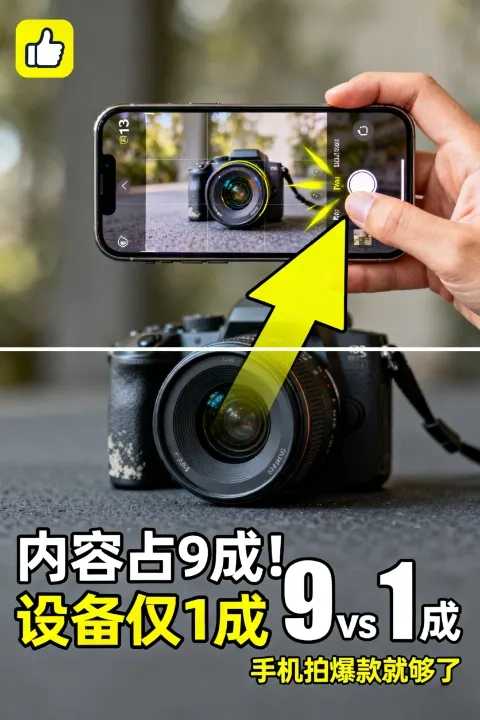
Why is content the "stabilizing force" of self-media?
The core competitiveness of self-media is always content, which accounts for more than 90% of the weight.
Even the best equipment is at most a bonus, accounting for less than 10% of the overall score.
The core content mentioned here includes polishing product copywriting , designing scripts, clarifying the theme, and providing ample lighting support.
Composition, scene selection, and color matching are all just auxiliary elements, icing on the cake.
Editing is also very important. Good editing can make the content rhythm more comfortable and the information conveyed clearer, but the premise is still that there is a good content foundation.
So really stop worrying about whether the camera is good or not, or whether the lens is expensive or not, these things really don't matter.
Go look through those viral videos, which one won because of equipment? They all won because of content that moved the audience.
If you really love cameras: Essential knowledge points for beginners
Of course, if you are really interested in cameras and want to explore them further, I can give you a simple introduction from a beginner's perspective.
Buying a camera and only using it in automatic mode is a huge waste; it's like buying a sports car and only driving it at basic speeds.
Try to learn to use manual mode (M mode) as much as possible to truly unleash the camera's potential.
Beginners don't need to try to learn too much at the beginning. As long as they understand the four core concepts of aperture, shutter speed, ISO, and exposure, they can take good photos.
These points are actually not difficult at all. You'll understand once I explain them to you in plain language.
Aperture: The "magic switch" that controls brightness and bokeh.
You can think of the aperture as the "gate" for light entering the lens; the amount of light entering per unit time is entirely adjusted by it.
The larger the aperture (note that the numerical value is actually smaller, for example, F1.8 is larger than F4.0), the brighter the image will be.
Correspondingly, the slower the shutter speed, the brighter the image will be, because the light stays on the sensor for a longer time.
However, a slow shutter speed has a problem: if your hand shakes even slightly, the image will easily become blurry or experience frame drops.
Besides controlling brightness, aperture has another super useful function—the larger the aperture, the more blurred the background.
When shooting portraits, a large aperture can make the subject stand out, blur the background, and instantly create a great atmosphere.
Exposure adjustment: Finding the "balance point" between light and shadow in the image.
In the camera viewfinder, there will be a line of numbers, and the small arrow in the middle is the exposure indicator.
When this small arrow is centered, the image exposure is balanced, neither too bright nor too dark.
If the arrow veers to the left, the image is too dark; if it veers to the right, the image is too bright.
When shooting for the first time, just keep an eye on this little arrow and adjust it to quickly find the right exposure.
Color temperature: The "palette" that determines the mood of an image.
Color temperature is a very interesting parameter. The higher the value, the warmer the image (e.g., yellowish or orangey); the lower the value, the cooler the image (e.g., bluish or cyany).
There's a small misconception here: the color temperature of a camera and the color temperature of a light source are opposite, so don't get them mixed up.
If you want to shoot in a warm and healing style, increase the color temperature; if you want to shoot in a cool and sophisticated style, decrease the color temperature. Just decide based on the theme of the content.
ISO and metering: lifesavers in low light conditions.
You can simply understand ISO as the function of "brightening" the image using digital technology when there is insufficient light.
The higher the ISO value, the brighter the image, but at the cost of more noise (high-end cameras have strong noise reduction capabilities, so the noise will be less noticeable).
Therefore, when there is sufficient light, use a low ISO to ensure a clean image; when there is insufficient light, increase the ISO appropriately.
Metering is a reference that the camera uses to help you determine the exposure, preventing the image from being too bright or too dark.
If the lighting in the shooting scene is relatively uniform, such as an outdoor overcast day or an indoor soft-light environment, evaluative metering is sufficient.
In scenes with strong contrast between light and dark, such as shooting a close-up portrait against the light, use local metering to precisely control the exposure of the subject.
Lens selection: Beginners don't need to buy too many; one zoom lens is enough.
Many beginners think about hoarding a bunch of lenses after buying a camera, but that's completely unnecessary.
For beginners, a 24-70mm or 24-105mm zoom lens is sufficient.
This focal length covers most shooting scenarios, whether it's landscapes, portraits, or still life, it can handle them with ease.
Macro lenses sound cool, capable of capturing extreme details like mosquito legs or dragonfly eyes, but ordinary people rarely use them in their daily lives.
Telephoto lenses are used to shoot distant objects, such as distant landscapes or stage performances, and are not very practical for ordinary self-media creators.
A telephoto lens combined with a large aperture has a very pleasing effect: when shooting portraits, the background blur is particularly natural, creating a great sense of atmosphere.
For the average person who wants to try this effect, a 70-200mm F2.8L lens is sufficient and offers great value for money.
As for super telephoto lenses with a focal length of 200mm or more, they are basically "exclusive equipment" for professional fields.
For example, when shooting sports events, birds in flight, or like Luo Hong, the top animal photographer in China, who sits in a helicopter to shoot animal migrations on the African savanna, you need to use this kind of super telephoto lens.
For ordinary people like us, super telephoto lenses are not only expensive, but also inconvenient to carry, making them a piece of equipment with a very high "idle rate".
In conclusion, the essence of self-media is content delivery, not a competition of equipment.
Having worked in the self-media industry for many years, I am increasingly convinced that true competitiveness stems from respect for and refinement of content, rather than blindly pursuing equipment.
Content is the spiritual bond connecting creators and audiences. It is the core carrier that evokes emotional resonance and conveys value propositions. Its weight is so great that it can leverage traffic and form the foundation for hit content.
Equipment is merely a tool for presenting content. No matter how good the camera or how expensive the lens, without the support of high-quality content, it is just an empty shell.
As the ancient Roman philosopher Cicero said, "Content is the vehicle of thought, and form is the garment of content."
The success of self-media has never been about the competition of equipment, but rather the accumulation of content, which is like "a person with knowledge and refinement naturally exudes elegance."
Hopefully, this sharing can help you avoid the misconception of "device anxiety" and focus more on content creation. Instead of agonizing over which camera to buy, focus on refining your scripts, optimizing your expression, and identifying the emotional triggers for your audience.
Pick up your phone now and try filming something you want to share. Believe that as long as the content is sincere and valuable enough, you will definitely gain recognition.
If you'd like to delve deeper into content creation techniques or advanced camera knowledge, feel free to follow me. I'll be sharing more practical tips and tricks in the future!
Hopefully, the article "Is Content or Filming Equipment More Important for Self-Media? Content Accounts for 9%, Equipment is Just an Auxiliary!" shared on Chen Weiliang's blog ( https://www.chenweiliang.com/ ) will be helpful to you.
Feel free to share this article's link: https://www.chenweiliang.com/cwl-33405.html