
Article directory
Deleting a Quark account might mean losing ten years' worth of cloud storage data, hundreds of bookmarks, and a whole set of autofilled passwords—and the master key to all of this is held in that phone number you've never even glanced at.
Let's put the conclusion on the table first: yes, and Quark has no intention of letting you register in any other way.
It recognizes Alibaba's unified account system, with the mobile phone number as the main entry point, and Alipay and Taobao accounts as the other two teeth on the same key.
The real challenge lies in the rules themselves—they are much tighter than most people realize, and they never warn you before you fall into a trap.
One phone number can only claim one Quark account.
This is the foundation of all the problems, and also the one where the most people stumble.
The official rules are straightforward: one mobile number can only be linked to one Quark account, and there is no room for "creating a backup account".
If you want to register another account, you'll need to provide another phone number.
Conversely, this also means that once your phone number is sold, your account also changes hands.
I've seen people carefully pack up their phone credit and unbind their bank cards before canceling their old phone numbers, but they forget that it's still linked to a cloud drive full of data.
When the day came that I needed a verification code for the new phone , the screen froze on the words "SMS sent," and I never received the text message.
Multi-device login: 2 mobile phones plus 1 tablet, that's the limit.
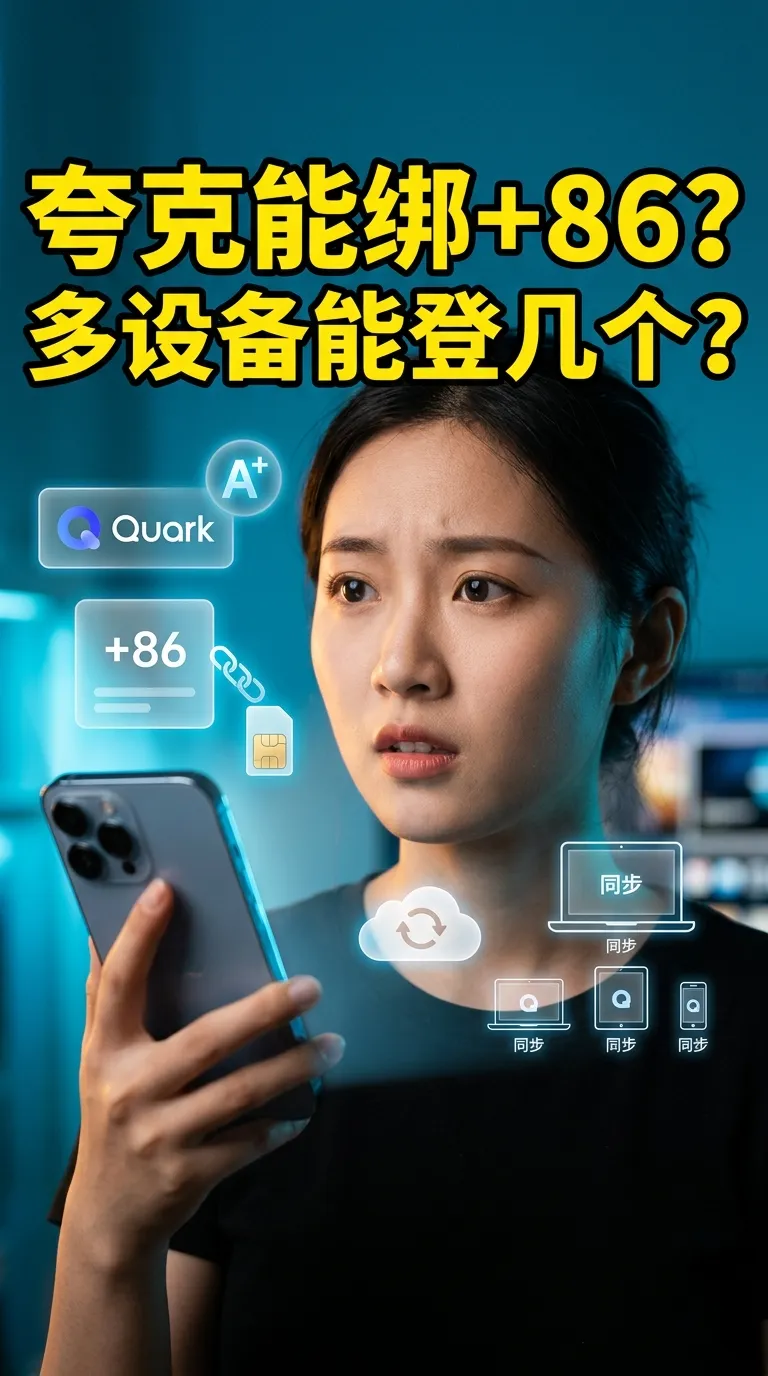
Quark manages online devices very strictly, with the browser and cloud storage sharing the same device management system.
In other words, if you log in to Quark Drive on a whim once, you'll quietly take up a spot on this list.
What happens after exceeding the limit?
Once a new device logs in, the one that logged in earliest or has been inactive the longest will be immediately removed.
Many people call this "account being kicked out," but the real culprit is actually the "auto logout" switch on your own device—it silently logs you out if you don't touch the screen for 15 minutes.
To stabilize the situation, go to [My] → [Settings] → [Account and Security] → [Device Management] and clear out the unused devices one by one.
Pay attention to those unfamiliar models labeled "offline"; they are the easiest to forget, yet they still firmly occupy a spot.
Synchronization across all three platforms requires that the login methods be exactly the same.
On Android , you use your phone number; on iPhone, you casually click "Continue using Apple ID"; and on PC, you log in with WeChat with one click for convenience—these three devices are essentially three unrelated strangers in the background.
Both WeChat quick login and Apple ID registration generate isolated sub-accounts, and the synchronization link is broken as soon as it starts.
To truly enable bookmarks, passwords, and browsing history to flow freely, you need to log in with the same mobile number across all devices.
Logging in only displays your ID card; the cloud synchronization faucet is off by default, and you have to turn it on yourself.
The path is slightly different for each platform: Android: Settings → Account & Security → Cloud Sync; iOS: Settings → Cloud Sync; PC: Top right menu → Settings → Sync.
After turning on the main switch, you need to check the specific items such as bookmarks, passwords, browsing history, and plugins one by one.
By the way, the "Home Navigation Bar" cannot be synced on iPhone. That item is grayed out on iOS, but it's not broken.
Why must I use the same phone number to receive the PIN when I get a new phone?
This is the toughest part of the entire rule, and also the easiest to underestimate.
After binding a Chinese virtual mobile number to Quark, you must use this bound number to receive verification codes when logging into your account on a new mobile phone; otherwise, you will not be able to retrieve your account or log in.
Quark offers three ways to recover your account: member order number, old mobile phone number, and account information verification.
If your old number is no longer in use, go through the "Old Mobile Number" route, select "No Longer Use," submit, and then fill in a new number you are currently using. With your membership order and auxiliary information verification, you have a chance to successfully change the binding.
But this is a remedy, not insurance.
I suggest renewing your personal number regularly, like wiping the table once a month.
If your phone number isn't renewed, it will be cancelled. You can only blame yourself for not renewing it on time.
You can use calendar software to set up automatic recurring reminders 3 days before the expiration date to prevent your number from being cancelled; it's very effective.
Once a phone number is cancelled, you can only register a new account; there's no way to recover it.
Instead of fantasizing about a reversal, it's better to accept reality and move forward.
Why PubliccodeThe platform is a trap.
When registering mobile apps, computer software, or website accounts using your mobile phone number , never use publicly shared online SMS verification code receiving platforms to avoid having your account stolen.
I didn't just say that offhand.
The China Internet Joint Rumor Refutation Platform clearly stated in its relevant announcement: "'SMS verification group' is a group that can provide mobile phone numbers and verification codes in large quantities. It is often accompanied by a series of illegal and criminal activities such as online order brushing, malicious 'coupon grabbing', and telecommunications network fraud, and it also poses a risk of leaking personal information."
Police in Gaoping, Shanxi Province, have cracked down on several criminal dens that infringe on citizens' personal information, seizing nearly 3000 mobile phones involved in the cases. The WeChat groups involved in the cases contained only mobile phone numbers and verification codes.
Guangming.com reported another, even more heartbreaking version: a mobile phone SIM card deliveryman, taking advantage of a customer's inattention, filled in the customer's newly registered mobile phone number into a SMS verification platform. The string of registration verification codes received on the customer's mobile phone was sold off one by one by him, earning nearly a thousand yuan in just a few days—while the customer's real-name account no longer belonged to him.
Yu Kui, a researcher at 360 Security, once made a very apt assessment: "Once a mobile phone is lost, a SIM card falls into the hands of criminals, or a mobile phone SMS verification code is hijacked, there is a possibility that one's identity may be misused and funds may be stolen."
People's Daily-affiliated media outlets have also quoted the views of Zhu Wei, deputy director of the Center for Communication Law Research at China University of Political Science and Law: "SMS verification codes are the core of account security, undertaking the task of real-name authentication and serving as a key to ensuring the safety of funds, but currently they are not receiving enough attention."
Imagine this: the shared phone number you bought for a few dozen dollars might be sold to twenty strangers at the same time, while you're using it to protect an entire data warehouse.
This is not a worthwhile deal no matter how you look at it.
Virtual phone number: That key only you know
Using a private virtual phone number can effectively protect your privacy and prevent harassment.
Imagine your Quark account as a precious treasure chest, filled with your life's moments and cherished memories. 📸🎁
And a virtual mobile phone number is like a key. Only you know its secret. Does anyone else want to open it? There are no doors! 🔑🚪
Furthermore, using a private, virtual Chinese mobile phone number to receive Quark SMS verification codes is like putting an invisible cloak on your account, protecting your privacy, enhancing the security of your Quark account, and effectively controlling spam interference, allowing you to roam freely and unrestrained in the world of Quark. 🧙♂️✈
Click the link below now to get your private Chinese virtual mobile phone number through a trusted channel▼
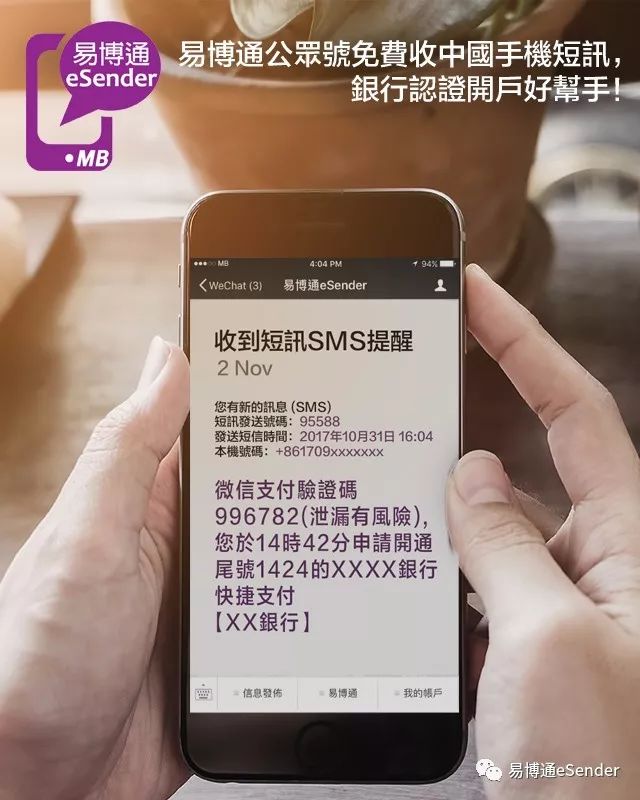
These pitfalls are mostly due to habit.
Set up a separate virtual private number specifically for registering services like Quark and cloud storage that require long-term use, while keeping the real number only for family, friends, and banks.
Write the expiration date of the number in your calendar; don't rely on your memory.
Periodically review the equipment management list to see if there are any models you don't recognize listed.
When logging in from multiple devices, stick to the phone number login method. While temporary authorization via QR code seems convenient, it will leave you with a lot of problems to fix later.
For accounts that need to be held long-term, stability and exclusivity are far more important than price.
After all, the value of an account is never in the moment of registration, but in the three years after you've used it.
Conclusion
I have always believed that account security is essentially a game of certainty, rather than a one-off technical choice.
We are used to scrutinizing every detail of explicit risks, yet we turn a blind eye to the phone number that silently bears all the burdens—this is a typical cognitive mismatch and a costly oversight.
From the binding logic of an Alibaba account to the concurrent limit of two mobile phones and one tablet, and the hard verification that the original number must be used to receive the code when switching devices, every rule points to the same underlying proposition: the irreplaceability of identity credentials.
When credentials can be shared, resold, and registered in bulk, the entire security system suffers a structural collapse at its very foundation.
True account sovereignty begins with your absolute exclusive control over that key.
Holding your number in your own hands, writing the due date into your calendar, and removing every unfamiliar device from your list—these three things take less than ten minutes, but they can protect the digital assets you've accumulated over the years.
May your treasure chest always be opened and closed by your own hands, rather than by someone else's whim.
Click the link below now to get your private Chinese virtual mobile phone number through a trusted channel▼
Hopefully, the article "Can Quark be linked to a Chinese mobile phone number? Q&A on multi-device login and account binding rules" shared on Chen Weiliang's blog ( https://www.chenweiliang.com/ ) will be helpful to you.
Feel free to share this article's link: https://www.chenweiliang.com/cwl-34546.html