
Article directory
I recently had dinner with an old friend who has been in the e-commerce business for almost ten years.
He bragged to me about how ruthless his team is now, scrutinizing conversion rates and average order value every day, pulling data dashboards at 2 a.m., and even revising customer service scripts eight times.
As I listened, I actually felt a little uneasy.
It's not that I think he doesn't work hard.
On the contrary, he tried too hard.
But I know one thing: his product category has been declining for five consecutive quarters.
This is a cruel but objective truth.
Stocks will inevitably shrink; this is an iron law of physics.
Any single existing market is destined to shrink.
This isn't a question of whether you're working hard enough.
This is a physical law governing the product lifecycle, and it has absolutely nothing to do with human willpower.
The product you make has its own life cycle, including its birth, aging, illness, and death.
Once the initial benefits are exhausted, users get tired of it, and alternatives emerge, no matter how much optimization is done, the curve will continue to decline.
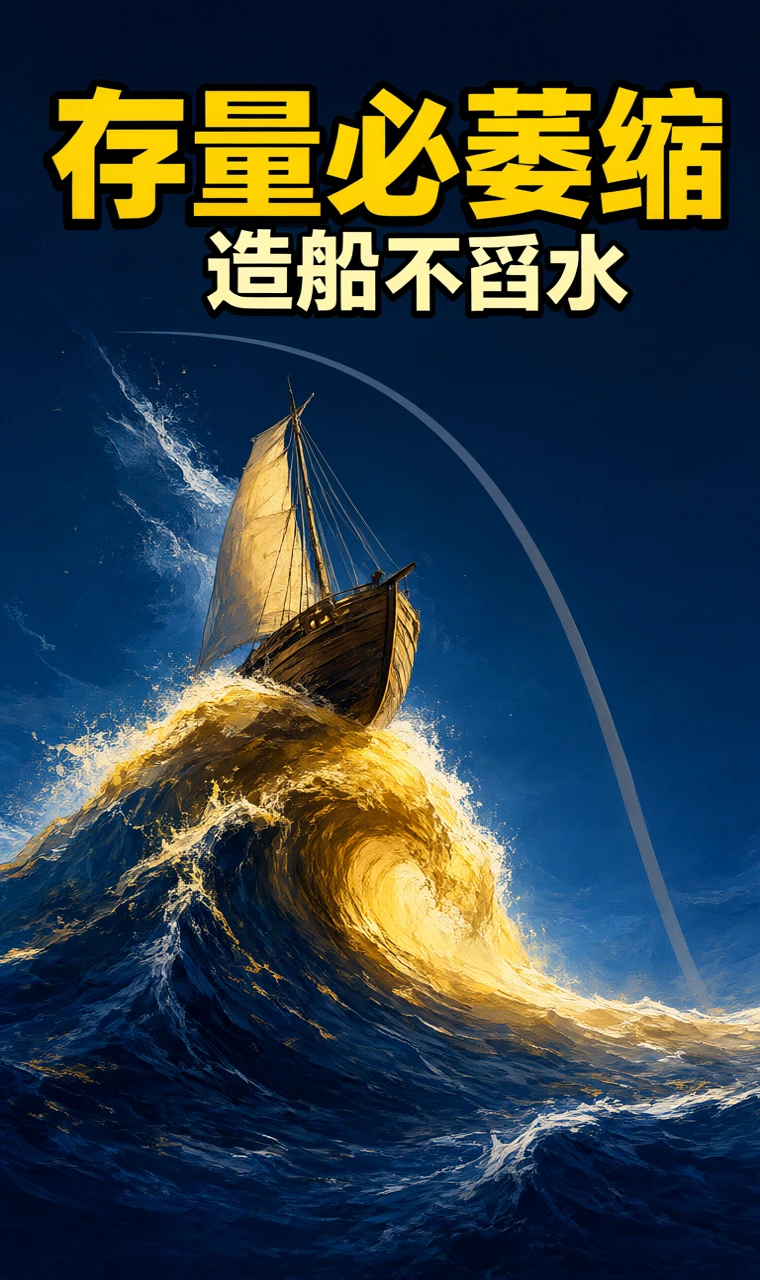
Scooping water from a leaky boat is the gentlest trap.
I've seen too many teams get more and more exhausted the more they work.
Where does the fatigue come from?
They devoted all their energy to one thing: how to slow down the decline on a curve that was destined to go downhill.
It's like being on a leaky boat, desperately trying to bail water out.
The actions were particularly touching.
Everyone was scooping water while sweating profusely, and the boss was scooping water too. No one dared to stop, because if they did, the water would overflow.
But the ending was actually written long ago.
The boat is leaking.
No matter how fast you scoop, you can't outpace the speed at which the water enters.
One day, the scooping speed could no longer keep up, and the entire ship sank.
This kind of busyness is a very gentle trap.
Because it looks particularly positive, resilient, and worthy of praise.
Ultimately, it is using tactical diligence to mask strategic resignation.
Apple's strategy is to keep building the next ship.
What is a truly superior playing style?
The first thing that popped into my mind was an apple.
Look at Apple, this company has never relied on a single product to last forever to defy the test of time.
When the iPod was at its peak, it didn't just sit there doing nothing; instead, it went on to create the iPhone.
The day the iPhone killed the iPod, it had already laid the foundation for the ecosystem of iPad and Mac.
Later, watches, headphones, services—one new curve after another, kept piling up.
The old one is declining, but that's okay, because the new one has grown.
It wasn't frantically scooping water from a leaky boat.
It was as if they were already building the next ship while the old one was still adrift.
This tactic, to put it simply, is extremely basic, but most companies cannot do it.
The core value of a boss is to step back and find new opportunities.
Why can't it be done?
Because there's a particularly inhumane aspect to this.
What exactly is the core value of a boss?
Many bosses, especially those who have worked their way up from the bottom in the business, are particularly prone to making a certain mistake.
When a problem arises in an existing business, his first reaction is to rush in and take over the work from the employees.
He revised the customer service scripts, oversaw the distribution of promotional materials, and even personally participated in the live stream.
He felt that this was called setting an example and being at the forefront.
But frankly speaking, this is precisely the last thing a boss should do.
Many bosses see this as a source of security, as if the sky will fall if they don't personally handle the business.
But the tighter you hold on, the less new things will grow.
When existing businesses can still generate cash flow, what the boss should really do is not personally step in to scoop up that water.
Instead, they freed up time and resources from the old business.
Why take it out?
Go find and define the next incremental opportunity.
Does this movement feel comfortable?
I feel uncomfortable at all.
Think about it: you're familiar with the old business, you can understand the data, you can lead the team, and you have definite things to do every day.
The next growth opportunity is vague, unknown, and may result in nothing even after six months of effort.
So human nature will push you back to your old jobs, to do the things you're good at and can see immediate feedback on.
But if you go along with human nature, the company is doomed.
Kodak and Nokia both stumbled because of scooping water.
Speaking of this, I'm reminded of two old, but chilling examples that I always get thinking about.
Kodak.
The digital camera was invented by its own people, the one from 1975.
But it couldn't bear to give up its lucrative old business of film, so it kept the technology locked away in a drawer.
By the time others have made digital technology successful, it will have sunk along with its crew.
Nokia.
The king of the feature phone era, with an astonishingly high market share.
When the wave of smartphones hit, it was still scooping up water from feature phones. By the time it tried to look up, the wave had already crashed in its face.
It's not that they don't try.
They simply spent all their energy trying to slow down a curve that was destined to sink.
This is somewhat similar to the second law of thermodynamics.
A closed system that doesn't continuously receive new energy will only descend into chaos and annihilation.
In the business world, the old curve is like a leaky ship; it won't get better on its own unless you actively build a new one.
The division of responsibilities must be clear; the two tasks should not be confused.
Returning to the division of labor, the requirements are actually extremely clear.
The old team had a very clear mission: to do just one thing.
Explore old products thoroughly, refine them, and squeeze out their remaining value to the fullest extent.
Optimize what needs to be optimized, improve efficiency where possible, and earn as much as you can each day.
This part of the value is the guaranteed cash flow, the lifeblood that fuels new business.
And what about the boss and core staff?
You have to force yourself to step out of your comfort zone.
Go and capture those small, unmet needs.
Go into the inertia of those old businesses, into the corners that are completely unseen, and find the next wave of resources.
These two things should not be confused.
If the old team is constantly being pulled away to work on new things, the cash flow of the old business will become strained.
If the boss is always being dragged back to old business to make money, new growth will never emerge.
A sense of security comes from knowing where the next wave of food will come from.
Honestly, I'm increasingly convinced that a company's sense of security is never something that can be built by simply guarding it.
No matter how tightly you guard it, that small plot of land will eventually harden.
Only when your focus shifts from "how to protect this small plot of land" to "where exactly is the next wave of food?", can you truly feel a sense of security.
Otherwise?
All your busyness, overtime work, and meticulous operations today are just planting seeds for tomorrow's crisis.
The boat is still leaking.
You're still scooping water.
The calm on the water's surface may fool others, but it cannot fool time.
So let's go back to that friend from the beginning.
I couldn't help myself that day and said something unpleasant to him.
I asked him, "Stop scooping water, look up and see where the next boat is."
He paused for a moment, then laughed and said, "You're right, but I really can't get away right now."
I understand that he couldn't get away from it.
I truly understand.
But some things, you have to get rid of sooner or later.
Pumping water before the boat sinks is completely different from waiting until the water reaches your neck.
What a great era, my friends.
Existing assets will inevitably die; accumulation is the key to survival.
Don't get so moved that you cry on a leaky boat.
I hope the article "The Existing Market Will Inevitably Shrink: The Harder the E-commerce Team Works, the More They Are Planting Landmines for Tomorrow's Crisis," shared on Chen Weiliang's blog ( https://www.chenweiliang.com/ ), will be helpful to you.
Feel free to share this article's link: https://www.chenweiliang.com/cwl-34631.html