
Article directory
You have a great idea: automatically sync content to ten platforms, create a data dashboard, or write a bot to post for you.
Then you open the developer page of the first platform and see "Submit for review", "Enterprise certification" and "Wait 3-7 business days".
The idea died in the application form before I even wrote a single line of code.
The issue isn't "whether or not they can connect to the API"—all 10 platforms have official APIs.
The problem is: some doors are open, some require an entrance fee, and some require you to prove who you are.
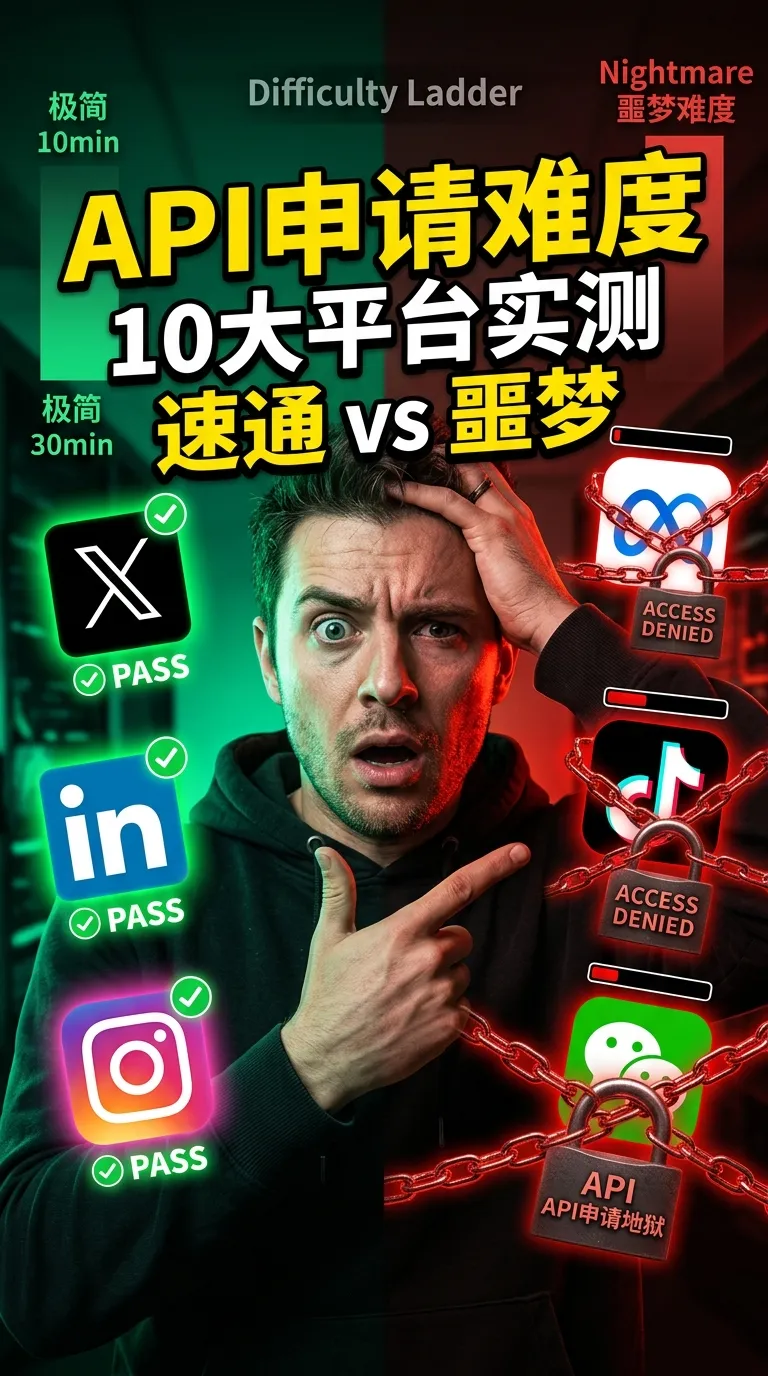
The following ranking is arranged from easiest to hardest to apply, helping you spend your time writing code instead of filling out forms.
First tier:TelegramBluesky, Mastodon – open in minutes with zero approval.
The Telegram Bot API is the easiest. Find @BotFather in Telegram, send /newbot, and you'll have a working token in 10 minutes.
It's free, has no audit requirements, and no barriers to entry, but the Bot API can only operate on channels and groups, and cannot read or write data from any user.
It's sufficient for content distribution, but not enough for data analysis.
Bluesky is built on the open AT Protocol, eliminating the need for an approval process. Create an App Password to directly call the REST API to post and read timelines.
From opening the document to posting the first programmatic message, 30 minutes is more than enough.
If your target audience is in the technology, AI , and policy circles, this 30-minute segment is extremely cost-effective.
Mastodon is based on the ActivityPub open protocol . You can get a token by registering an application on the target instance, which also requires zero approval.
The only thing to note is that Mastodon does not have a "global API"; each instance has its own independent API endpoint.
Your robot should register with the instance it wants to deploy to.
Second tier: X andYouTubeSelf-application is possible, but there are additional conditions.
Starting in February 2026, X's developer process will be significantly simplified. Register at console.x.com, accept the agreement, create an application, and receive an API key in 15 minutes—no manual review required.
Sounds great? Take a look at the bill: $0.005 per read, $0.015 per post, and $0.20 per post with a link.
The old free tier has been discontinued, and the $200 per month Basic tier is no longer accepting new users. New developers will be charged on a pay-as-you-go basis.
A small automation project can easily burn through hundreds of dollars a month. The barrier to entry for X is not the process, but the wallet.
YouTube Data API v3 can be self-activated in Google Cloud projects . You can get the API key in a few minutes without spending a penny.
But there are two "buts".
First, the quota is very tight: 10000 units per day, 100 units are used up in one search call, and 100 searches will use up the daily quota.
Second, sensitive permissions require verification: if it's just searching and reading public data, there's no problem; but if you need to manage channels on behalf of users and read analytics data, you need to go through Google's OAuth security verification, which usually takes several weeks.
The third tier: Threads and Pinterest need to pass the app review process.
The Threads API is a public API that will be released in mid-2024 . It requires creating a Meta developer application and applying for permissions, and the review process is much more lenient than that of Facebook and Instagram.
It supports text, images, and carousels. If you already have followers on Instagram, Threads will inherit those social connections, giving you an audience right from the start.
The Pinterest API requires developer accounts and application approval ; the key is to clearly explain "what you want to do with the API".
The approval rate for routine PIN sending and data reading permissions is good.
Fourth Tier: Facebook, Instagram, TikTok – a series of hurdles
Creating a Facebook app isn't difficult; the challenge lies in obtaining useful permissions. Managing Pages, accessing insights, and serving ads—almost every aspect requires enterprise verification and individual permission approvals.
Following the Cambridge Analytica scandal, access to public data was tightened to "data only for your own account".
The prerequisites for the Instagram Graph API are numerous : a business or creator account, a linked Facebook Page, and then core permissions must pass Meta's App Review—recording a demo video, writing a usage description, and waiting for approval.
The old version of the Basic Display API was discontinued in 2024, and there are no shortcuts.
TikTok is widely considered the most difficult hurdle to overcome. The company's qualification review, developer portal application (which takes 3-7 business days and is not guaranteed to be approved), Content Posting API, and Research API are each subject to separate approval processes.
The Research API is only open to research institutions, and it also restricts countries and regions, limits data fields, and forces data to be refreshed within 15 days.
If you want to automate your TikTok process, please allow a one-month application period.
A table to understand the API application difficulty of 10 platforms
| platform | Application difficulty | Cost | Who is it suitable for? |
|---|---|---|---|
| Telegram | ★ | Free | Channel robots, content distribution |
| Bluesky | ★ | Free | For tech/AI enthusiasts, get started quickly! |
| Mastodon | ★ | Free | Open source community, privacy-sensitive audiences |
| X/Twitter | ★★ | Pay-As-You-Go | Projects with sufficient budget |
| YouTube | ★★ | Free (limited quota) | Video data,SEOtool |
| Threads | ★★★ | Free | Brands that already have Instagram followers |
| ★★★ | Free | E-commerceVisual content | |
| ★ ★ ★ ★ | Free | Team with corporate qualifications | |
| ★ ★ ★ ★ | Free | A team that takes Meta matrix seriously | |
| TikTok | ★ ★ ★ ★ ★ | Free | Patient and qualified organizations |
In short: open ecosystems are ready to use immediately, meta-based systems require data preparation, and TikTok requires patience.
My suggestion: Follow this route.
The first step, which you can take action on today, is to use Telegram or Bluesky to automate the process and verify whether your idea is worthwhile.
The second step, once the idea is established: add Threads and YouTube to cover both "short content + long video".
The third step, when preparing to burn money: take on X, calculate the cost per unit, and then increase the volume.
The fourth step, after obtaining the company's qualifications: finally tackle TikTok, Instagram, and Facebook, preparing all the qualification materials at once, so that the review of the three companies can proceed in parallel.
The most expensive cost is never the application fee, but spending three weeks on the wrong platform.
Go through the open door first, make the thing, and then go back to pry open the hard locks.
Hopefully, the article "Ranking of the Difficulty of Applying for APIs on the Top 10 Social Platforms: From a 10-Minute Speedrun to Overcoming All Obstacles" shared on Chen Weiliang's blog ( https://www.chenweiliang.com/ ) will be helpful to you.
Feel free to share this article's link: https://www.chenweiliang.com/cwl-34543.html